Building a SaaS product is one of the most exciting things a founder can do. It's also one of the easiest ways to spend £50,000 building the wrong thing. The antidote is a well-executed MVP — but most founders misunderstand what that actually means.
An MVP isn't a broken product. It isn't a landing page with a waitlist. It's the smallest version of your product that delivers genuine value to a real customer — and tests your most critical assumption in the process.
Step 1: Define the one problem you're solving
Every failed SaaS product can be traced back to one of two things: solving a problem people don't actually have, or solving a real problem in a way people won't pay for. Your MVP is designed to find out which one you're facing — before you build everything.
Before you spec a single feature, write a one-sentence problem statement:
"[Customer type] struggles with [specific problem] because [root cause]. We solve it by [core mechanism]."
If you can't write this clearly, you're not ready to build yet.
The 70% Scope Cut Rule
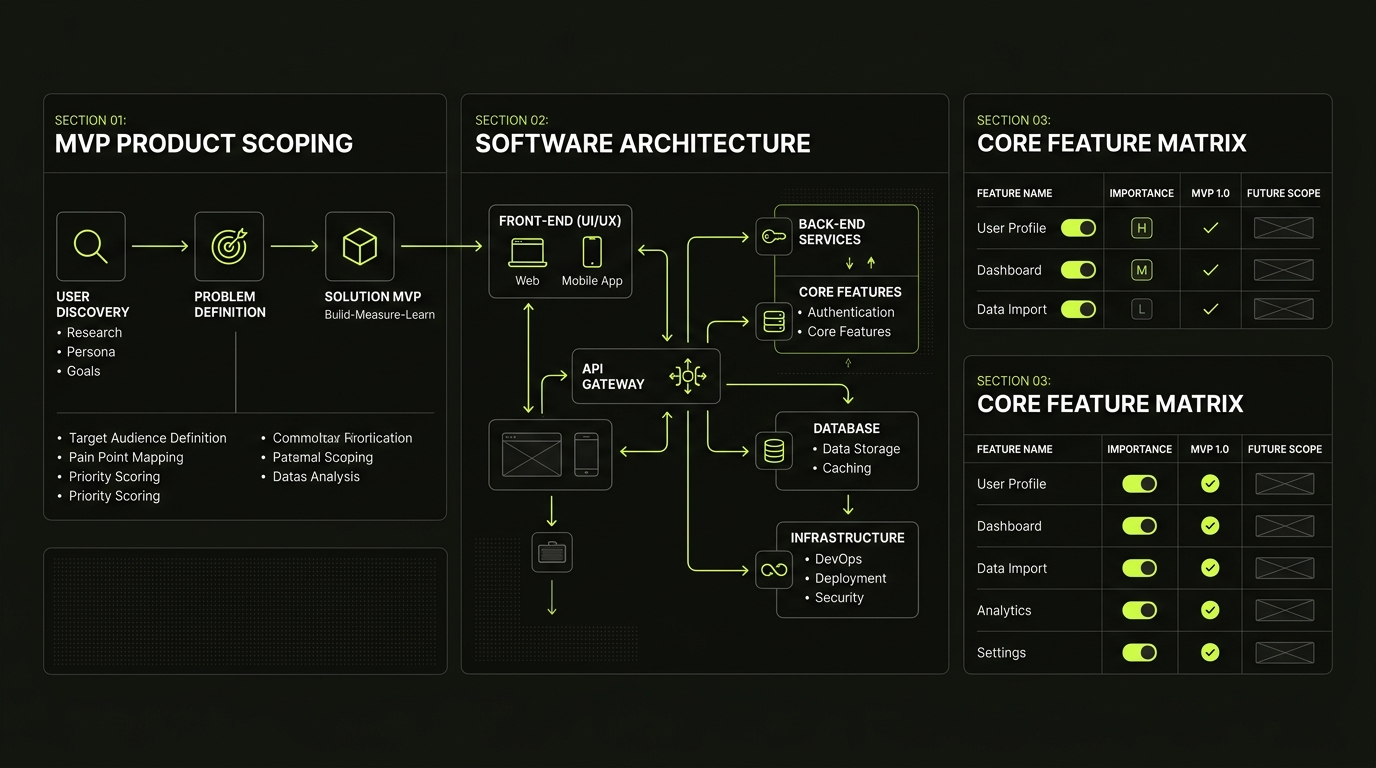
Write down every feature idea. Then trim 70% of them. An MVP should solve one workflow seamlessly rather than attempting ten things adequately.
Step 2: Identify your riskiest assumption
Every product is built on a stack of assumptions. Your MVP should test the most dangerous one — the assumption that, if wrong, makes the whole business unviable. Usually this is: "Will people actually pay for this?"
Design your MVP to answer that question first, above all others.
Step 3: Scope ruthlessly
Write down every feature you want in the product. Now cut 70% of it. An MVP should do one thing extremely well, not ten things adequately.
Prioritise features using this filter:
- Must have: Without this, the product doesn't work for anyone
- Should have: Significantly improves the experience but isn't blocking
- Nice to have: Cut for now. Add it in version 2.
Step 4: Choose the right development partner
Non-technical founders often assume they need a technical co-founder to build a SaaS. That's one path — but it's not the only one. A development studio that combines product thinking with engineering can take you from a rough brief to a launched product, and guide decisions along the way.
Look for a partner who asks questions about your customers before they ask about your tech stack. The best ones know that product decisions come before engineering decisions.
Speed Matters in Validation
A SaaS MVP built in 8–12 weeks lets you launch, collect real user feedback, and iterate before running out of momentum or budget.
Step 5: Launch before you're ready
The version of your product you're embarrassed to show people is usually exactly the version you should show them. Real user feedback — not your assumptions about what users want — is the most valuable thing in early-stage product development.
Launch to a small group, learn fast and iterate. That's the whole game.
Ready to build your SaaS MVP?
At Battlens, we turn SaaS ideas into scalable digital products — from scoping and architecture to full-stack engineering and launch.
Explore SaaS Product Development ↗